Gentle Reminder: It’s Just Food

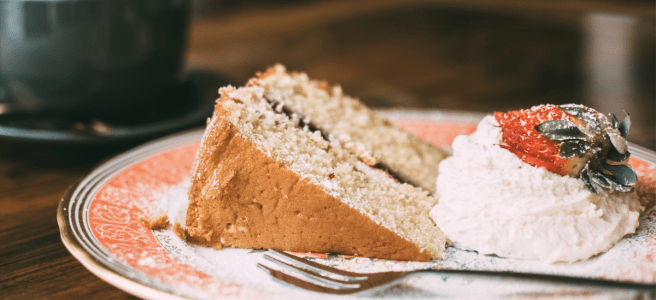
A piece of vanilla sponge came on a plate with a dollop of cream, a strawberry and a small fork.

Some food has a higher nutritional content than other food. Some food is produced more ethically than other food.  Neither of these facts can be disputed.

What is up for debate is how helpful it is for you psychologically and emotionally to label food as “good” or “bad”, “healthy” or “unhealthy”.

If you consider one food more off-limits or “naughty” than another, which one are you most likely to reach for when you’ve had a bad day? Or when you need a pick-me-up? Or when you want to treat yourself?

Put it another way: we don’t binge on broccoli.

Continue reading “Gentle Reminder: It’s Just Food”

How are You Going to Eat for the Rest of Your Life?

Listen. Can you hear that?

That’s the sound of people everywhere falling off the New Year diet wagon.

Maybe you’re one of them.

Maybe you bought into the much-touted idea that enjoying yourself at Christmas is ‘sinful’.

Maybe you felt you must make ‘amends’ by starting some self-proclaimed diet guru’s “no fail, instant weight-loss, guaranteed results, easy 12-week eating plan”. (If I sound a bit angry, I am, because these people make my job so much harder).

Maybe you now find yourself out of control with food.

I’m sorry if that’s the case.

It’s not your fault.

Continue reading “How are You Going to Eat for the Rest of Your Life?”

What is eatonomy?

eatonomy: the ability to make decisions about what, when and how much to eat based on personal instincts and preferences, independent from external influence, direction or control.

I started turning to food when I was around 12 years old. My emotional attachment to it had begun before that but I was about 12 when I started to binge habitually, in secret, to the point that I felt sick. As a result, I began to put on weight.

At 19, I did what we’re told to do if you want to lose weight – I started dieting. The restriction of dieting only served to ramp up my binge eating. With every diet, I’d lose weight and put it back on, and a bit more besides. As my weight increased further, my self-esteem, which had always been really low, plummeted even further. Continue reading “What is eatonomy?”

What Did You Learn About Food Growing Up?

Lunchtime had ended at my primary school. I sat alone in the dining hall, apart from two teachers who stood over me.  They stared resolutely at me, while I stared forlornly at a plate of cold cottage pie. Everyone else had gone out to play and I could hear the familiar noises of the playground in the distance.

I was told I couldn’t leave until I’d finished my lunch.

At 10 years old, I truly loathed cottage pie. It was My Completely and Utterly Absolutely Worst Food in the World Ever, apart from my Mum’s curried egg (sorry, Mum).

Continue reading “What Did You Learn About Food Growing Up?”

How Do You Heal Your Relationship with Food?

Trying to heal your relationship with food can feel like a mammoth undertaking, especially if it’s been dysfunctional for as long as you can remember.

I try to keep it simple.

Continue reading “How Do You Heal Your Relationship with Food?”

Why Should We Make Peace With Food?

It’s my job to help people find autonomy with food.

I’m a psychotherapist who works exclusively with people who overeat.  I use the term “emotion-driven overeating” to encompass the overeating spectrum that includes compulsive eating, emotional eating and binge eating disorder.

But why is it important to have an autonomous relationship with food?  After all, some would argue that most people have a dysfunctional relationship with food, that there is no “normal”.  So what’s the big deal?

Continue reading “Why Should We Make Peace With Food?”